

01 Content
“High-end” is a word that gets used a lot, but it’s often reduced to finishes or price.
In reality, it has very little to do with how expensive something is on paper.
You can walk into a space that used premium materials and still feel like something isn’t quite right. And you can walk into something more restrained that feels calm, cohesive, and well put together.
The difference usually comes down to how the space was designed, and just as importantly, how
it was built.
A big part of it is restraint.
When too many materials or ideas are introduced, the space starts to compete with itself. It feels busy, even if everything in it is “nice.” The spaces that tend to hold up over time are more controlled. A smaller palette, used consistently, gives everything room to breathe and read clearly.
Proportion plays a quiet but important role.
It’s not something people always notice directly, but they feel it immediately. The relationship between ceiling height and cabinetry, the width of panels, the spacing between elements. When those decisions are considered, the space feels more natural. When they’re not, things start to feel slightly off, even if the materials themselves are good.
Then there are the details.
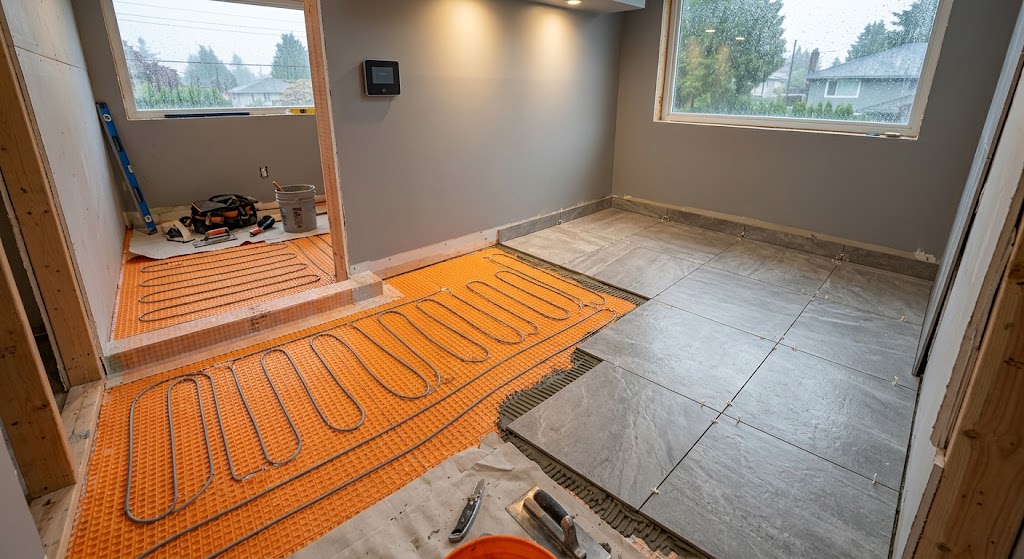
Not decorative details, but how things actually come together. Where materials meet, how edges are finished, whether alignments carry through from one element to the next. These are subtle decisions, but they create a sense of precision that people often interpret as quality.
This is where workmanship becomes critical.
A well-designed space can easily lose its impact if it’s not executed properly. You start to see it in small ways. Gaps that aren’t consistent. Lines that don’t quite align. Transitions that feel abrupt instead of intentional.
Good construction work isn’t loud, but it’s very noticeable once you know what to look for. Everything sits the way it’s supposed to. Joints are clean. Materials are handled with care. It gives the space a sense of confidence, like nothing was rushed or forced into place.
Lighting also plays a role in how everything reads.
When it’s treated as an afterthought, even well-chosen materials can feel flat. When it’s considered early, and layered properly, it brings out depth and texture, and the space becomes more comfortable to be in, not just something that photographs well.
There’s also a point in most projects where restraint matters again.
It’s easy to keep adding more toward the end, another finish, another feature, another detail. But that’s usually where things begin to feel heavy. The strongest spaces tend to feel like they stopped at the right moment, nothing unnecessary, nothing missing.
When a space feels high-end, it’s usually not because of a single element.
It’s because everything feels aligned.
The design decisions make sense.
The materials relate to each other.
The construction supports the design instead of working against it.
It comes across as calm, resolved, and considered.
That’s what people are really responding to, even if they describe it with a single word.
06 Insights